Don’t Get Burned: Coffee Trailer Scams to Avoid Before You Buy
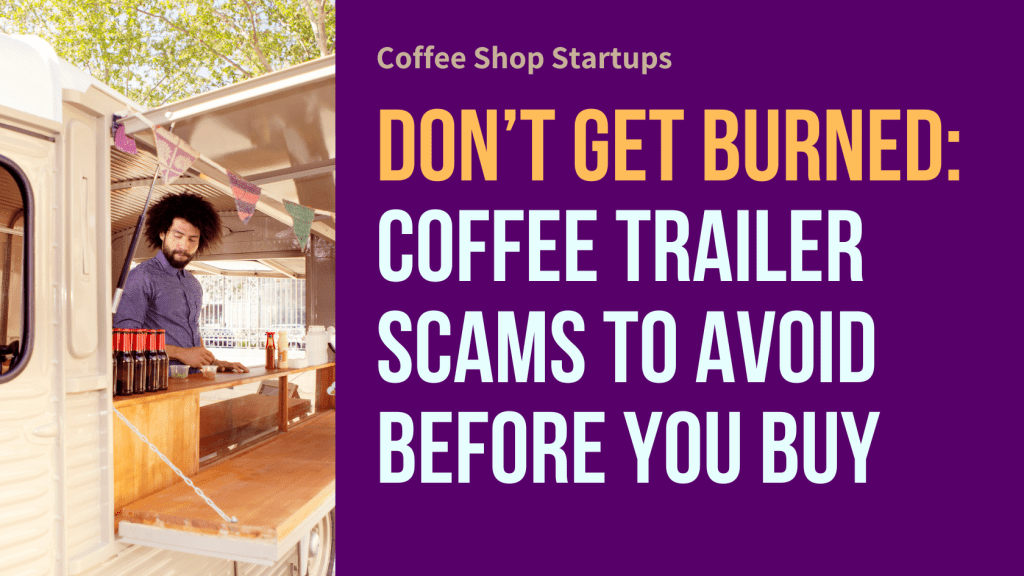
Have you decided to start a coffee trailer business with a used trailer?
Buying a used trailer or truck to refurbish into a coffee business is one of the smartest ways to save money, but it’s also where scammers love to operate, so it will be important to tread carefully.
With many first-time buyers entering the mobile coffee and mobile food world, shady listings and sneaky sellers seem more common to me as I regularly check out Craigslist listings and the FB Marketplace.
Coffee Trailer Buyer Beware
Starting a coffee truck can be exciting, but getting ripped off before your mobile business gets off the ground can be devastating.
The last thing I want is to see you ripped off before you even have a chance to start your coffee trailer business. Therefore, I want to spend some time today walking you through the biggest traps trailer and truck buyers fall into, and how to avoid them so you don’t lose thousands before you even brew your first latte.
Why Trailer Scams Are More Common
Many aspiring mobile coffee and food business owners, as well as other mobile retail owners, can save money by buying a used truck or trailer to customize and refurbish. This can be a good option if you understand the work and are prepared for it.
It’s not hard to imagine that you don’t often buy a used trailer or truck, so many buyers are inexperienced with the process. This creates opportunities for scammers.
The National Association of Attorneys General stated that as many as 1 in 44 titles in various states are fake, according to reports.¹ The sad news is that many title fraud schemes go unreported.
Some of the data is hard to compile, and thus, it’s hard to read the tea leaves. But from what I’m seeing, it looks like many scams target people who:
- Have never purchased a trailer or truck before
- Don’t know what paperwork to look for
- Are shopping online and out of state
The last one seems normal, as I’m going to take a guess and say that 9 out of 10 people do some online research on trailer and truck options and availability. This creates another avenue for scammers to entice future business owners. In fact, the use of AI and AI imaging to develop fake pictures while pressuring people to put down a deposit.
Scam #1: Trailers Without a Clear, Transferable Title
One of my hobbies is reviewing trailers, vans, and trucks that can be converted into mobile coffee businesses. It is not uncommon for people to sell their trailer or truck and list it as not having a title. Maybe they have a title, but it doesn’t match the VIN or other identifiers. You can see why this can be a problem.
Every trailer built from 1980 to the present requires a VIN. Before 1980, manufacturers added their own unique numbers, but they were hard to track. Nevertheless, they did offer some numbers, but they are often short and generalized. At the very least, those numbers should be tied to the physical paper title associated with the trailer.
I’ve noticed that some sellers don’t have a valid title — or they have a title that doesn’t match the VIN on the trailer. Others claim “lost title,” or they bought it without a title.
These should be huge red flags. While the trailer could be appealing, this is why it's dangerous:
You may not be able to register the trailer.
Since there is no paperwork associated with the trailer, you may encounter major roadblocks. For example, in most states, a missing or unclear trailer title is not a minor paperwork issue. It can be a deal-breaker.
Without a clean, transferable title, the state’s department of motor vehicles may refuse registration, require costly bonded titles, or even treat the trailer as potentially stolen. From the state's perspective, they don’t want to approve a potentially fraudulent sale.
For mobile coffee businesses, no title often means no permits, no insurance, and no legal way to operate.
Can't license it for commercial use.
If you can get a clean title with ownership, you’ll likely be able to insure the trailer or be legally allowed to use it for commercial use.
It could even be buying a stolen unit.
You never know what you’re buying and who you are buying from. The seemingly nice person who is nicely dressed could be the guy who sells you a stolen trailer.
How to protect yourself:
Fraudsters are always trying to stay ahead of the game here, but there are a few basic things you can do to ensure that you are making a legit purchase.
Match the VIN on the trailer to the VIN on the title
The VIN on a newer trailer can be marked somewhere on the hitch, chassis, or inner door. If the VIN isn’t visible in or around these common places. Consider asking
Call your state licensing department to verify
You can call, or in some states, you have online access to verify a VIN. You may check with your state highway patrol or other authorizing agency or department. For example, in the state of Washington, you can set up an appointment for a physical check.
Never buy a trailer where the seller “isn’t sure” about paperwork
Don’t fall for this “I don’t know business.”
Oh, “But it’s a great deal!”
Sorry, no clean paperwork, walk away.
If the owner is unsure of the paperwork, that is a giant red flag. The fact of the matter is that paperwork is an important part of the transaction. In order to protect yourself and avoid getting into trouble down the road, ensure that the paperwork is clean and that it is also legit. Remember, fraudsters are great at making counterfeit titles.
Scam #2: Fake or Stolen Online Listings
Scammers often take photos from legitimate sellers and repost them at unrealistically low prices. If you bought or sold anything online and spent a little time searching for any products, you may have noticed this tactic. Thieves snap a screenshot and edit their listings to make them sound legit, and then they’ll wait.
They’ll pressure you to:
- Wire money or use an app-based system.
- Pay a deposit fast
- Skip seeing it in person
The reasons for doing any of these things are self-explanatory, but scammers know that you’ll likely be suspicious, so they’ll have a compelling, detailed story.
Here are a few red flags that it’s likely a scam:
- Price is way below market
- Seller avoids video calls
- Only wants to communicate via text or email
There may be reasons for each of these that may seem legit, but if they can’t speak with you, provide you with a valid telephone number, email address, or video, then I would rather walk away.
Important: Never send money without seeing the trailer or verifying the seller.
Protection steps:
- Ask for a picture of a specific item, such as inside the breaker box, the water pump and filter, or any specific element or piece of equipment they may not have access to, without having to retake the picture.
- Reverse-image search the photos. This may or may not work, because many listings are either on an app or too new to be indexed by a reverse image.
- Ask for a video walk-through with today’s date.
Check-In Spot: You can mention which platforms have the most fake listings in your experience.
Scam #3: Hidden Structural Damage
You want to sell coffee, but in doing so, you might be buying a lemon. In fact, a trailer might look good in photos, but underneath the paint or interior walls could be a mess.
Rusted or rotting frames
When I bought my used trailer, I found rotting frames. Many of these frames were not connected to each other because the staples used had rotted out. It took me about two months to complete the reframing. Extra weekends and extra money were something that I didn’t budget for.
Bent axles
It’s important that you inspect the axle(s) for damage, cracks, and rust. Having your axle break during your haul could be extremely dangerous. Go under the trailer and inspect its condition. Now, depending on the age of the trailer or truck, you might expect some normal wear and tear. If you are unsure, you might want to have a mechanic look at it.
Water-damaged floors
Soft, squishy flooring is a tell-tale sign of water damage. Replacing a floor isn’t easy, and it should significantly reduce the trailer's price. If you purchase a used trailer or truck with significantly damaged flooring, be prepared to remove and replace it.
Electrical nightmares
Now you might be replacing the interior lighting altogether, so this may not matter. Still, it’s good to check the electrical. It’s true that sellers rarely highlight these issues because fixing them is expensive. But if you find anything wrong with the lighting, you can use it as a negotiation point to lower the cost.
Basic inspection checklist:
- Look under the trailer with a flashlight
- Check welds, joints, and rust (look for signs of cracking)
- Test all lights and wiring (interior and exterior)
- Inspect the floor inside and underneath
If I were buying a trailer to refurbish or turn into a coffee cart, I would not compromise on the condition of the framing, hitch, or axle. Additionally, water damage to the floor that was fixed can continue to cause damage long after you buy it.
A Safe Buying Process (Your Step-by-Step Path)
While there may not be a foolproof way to avoid getting scammed, you can take steps to reduce the chances. Hopefully, some of the steps I’ve already outlined will help you as you go out looking for trailers and trucks to refurbish into coffee businesses.
Let’s quickly review a few essential steps to help you avoid becoming the victim of a scammer.
Step 1: Do your market research (know what you want and your budget)
Step 2: Verify documentation (utilize your local/state agencies to verify)
Step 3: Inspect the trailer (Bring a second pair of eyes with you!)
Step 4: Review code + equipment needs
Step 5: Make a secure payment (never feel pressured)
Step 6: Register and insure your trailer
I definitely wish I had read these tips before purchasing my used trailer. It would certainly have made my job a lot easier to plan for and budget for the additional expenses. While I may still have purchased my trailer, having the additional information would have affected my calculations and expectations. Likewise, you want to be sure what you’re getting yourself into and have the information you need to make a good decision that works for you.

Get The Ultimate Guide!
Start a Coffee Truck Business
Affordable. Relevant. Comprehensive.


¹www.fox26houston.com/news/authorities-call-attention-to-vehicle-title-scams
* The information on this page is for educational purposes only. We do not offer legal or investment advice.

Coffee Shop Startups
Based in Seattle, Washington, USA, Coffee Shop Startups is dedicated to providing you with the most relevant information on how to start a coffee shop business successfully. Over the last 11 years, we've helped thousands of aspiring coffee business owners worldwide. We harness the experience, wisdom, and knowledge of many successful coffee shop owners to help you increase your chances of success and profits. We support business owners who want to start a coffee business by providing them with valuable information on starting their coffee business successfully.