How Much Money Does a Coffee Shop Owner Make?
How Profitable Is a Small Coffee Shop?

How much can a coffee shop owner really make?
The honest answer is: it depends.
A small coffee shop owner might earn $55,000 per year, while an experienced owner with a busy location may earn well into six figures. The difference isn’t luck—it’s understanding the numbers that drive revenue and profit.
In this guide, we’ll break down:
- Typical coffee shop revenue
- How profits are calculated
- Real income examples
- The biggest factors that determine how much you actually take home
While revenue projections vary per coffee shop, an owner can make between $50,000 and $175,000 yearly. That’s a big swing, but as you’ll soon see, your annual income depends on several key factors, which we will discuss very soon.
The global specialty coffee market was estimated at approximately $111.5 billion in 2025 and is projected to grow at an annual rate of about 10.8% through 2033, reflecting continued consumer demand for premium coffee experiences, according to Grand View Research. On top of that. Specialty coffee consumption remains at record highs in the United States, with 47% of American adults reporting they drank a specialty coffee in the previous day, according to the National Coffee Association.
How much of that money will your coffee shop be able to generate?
Let’s explore this topic further.
Several factors determine coffee shop revenue and income.
These include:
- Your coffee business concept
- Physical location
- The volume of customer sales and gross receipts
- Level of competition and substitutes
- Target market
- Menu price points
- Initial startup costs
- Operational costs (variable and fixed costs)
Estimated Coffee Shop Owner Revenue
The following are conservative planning estimates based on our experience working with coffee businesses. Actual revenue depends on location, hours, pricing, customer traffic, and operational efficiency.
Coffee business Income estimates include:
| Small Espresso Catering | $35,500 – $75,000 |
| Coffee kiosk: | $75,000 – $150,000 |
| Mobile Coffee Truck: | $150,000 – 250,000 |
| Drive-thru Coffee Stand: | $250,000 – 600,000 |
| Brick-and-Mortar Coffee Shop: | $300,000 – $600,000 |
| Full Coffee shop & bakery: | $310,000 – $600,000 |
| Cafe & bar: | $330,000 – $800,000+ |
| Coffee Shop, bar, and kitchen: | $400,000 – $650,000+ |
However, these annual revenue estimates are specific to their locations, hours of operation, and sales volume. Your income will be your gross revenue minus the costs. As a coffee shop owner, your job is to increase the profit margin, number of sales, and gross receipts while reducing costs.
Let’s explore how much money a coffee shop can make a bit further below.
Alright, so let’s get started!

Average Coffee Shop Owner Income
How much money does a coffee shop owner make?
If you’re looking for one average salary, you’re probably going to be disappointed.
The truth is that a coffee shop owner’s income depends on several key factors—including your sales volume, average customer ticket, operating costs, and profit margins. That’s why one owner might earn $60,000 a year while another earns well into six figures.
Instead of giving you a generic number, I’d rather show you how to estimate your own potential income using real-world examples and practical calculations.
After working with aspiring coffee shop owners for years, I’ve seen small coffee businesses do much more than generate income. They’ve created flexibility, financial independence, and an entirely new lifestyle for many owners.
A profitable coffee shop doesn’t happen by accident. It starts with careful planning, realistic financial projections, and understanding the numbers that drive your business.
Let’s break it all down.

Coffee Shop Revenue & Owner Income
How to Estimate Your Earnings
Your coffee shop’s Total Revenue is the amount of money your coffee shop makes altogether. It is generated from all the sales that occur throughout the day, week, and month.
Your total revenue embodies all the money you pay for coffee, tea, soda, muffins, pastries, food, merchandise, etc. However, it does not include the cost of doing business. We’ll talk about that later. Your job is to generate as many sales as possible to boost your transactions, sales receipts, and your coffee shop owner’s income.
Let’s take a look at some sample revenue scenarios below: We have created three coffee shops that work from 7 a.m. to 7 p.m. – and determined their daily and monthly revenue for simplicity. The sample revenue does not include costs to start a coffee shop. Mix and match your estimated numbers to determine how much money your coffee shop will make.
Annual Coffee Shop Revenue Estimates:
From these income scenarios, the total annual gross income would be:
- $190,080
- $524,160
- $1,166,400
Just plug in the numbers for your estimates, and what do you get?
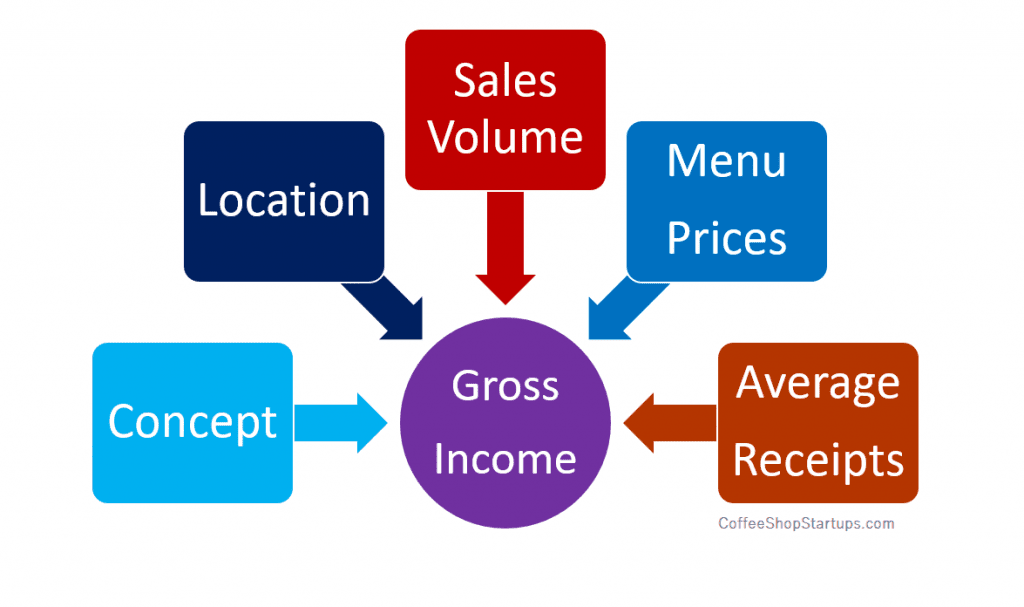
Coffee shop revenue is based on two primary things:
Two numbers have the biggest impact on your coffee shop’s revenue:
- Daily Sales Volume (how many customers you serve)
- Average Ticket Size (how much each customer spends)
Even small improvements in either one can significantly increase your annual revenue. Increase both at the same time, and the impact can be dramatic.
While factors like location, operating costs, and competition also affect your income, these two metrics give you the greatest control over your financial success.
Throughout this guide, we’ll show you how increasing your daily customer count and average ticket size can dramatically improve your coffee shop’s profitability.
Hidden Factor: Time Plays a Role in Making More Money
As you can see by the tables above, time also plays an important factor. The days you are open, from 22 days to 30 days can dramatically impact how much money you make. Of course, you will also bear some variable costs, such as labor and inventory, but you are still likely to make a profit.
In addition, how much money you make is also determined by how many years you’ve been in business. Presumably, your coffee business will make more money this year than last year. In other words, due to factors like efficiency, brand awareness, less waste, and more loyal customers offering repeat business – you will probably make more money in your 5th year than in your first year.
How does time play in making more money every year?
- Increased number of days open
- Greater operational efficiency
- Less waste
- More loyal customers

You’ll need to factor in…
Your Coffee Shop Sales Volume
Sale numbers reflect how many customers walk through your door or drive to your drive-thru coffee stand window and buy something.
Each purchase equals one sale.
The more buying customers you have, the more sales ring up, which equals the more revenue your coffee shop will have.
For example, let’s say that you average 200 customers a day. A 20% increase from that will bring up to 240 customers daily.
Depending on the sales receipts, this can dramatically boost your monthly revenue. Even a modest increase of 10% at this existing volume would generate 600 new monthly customer receipts!
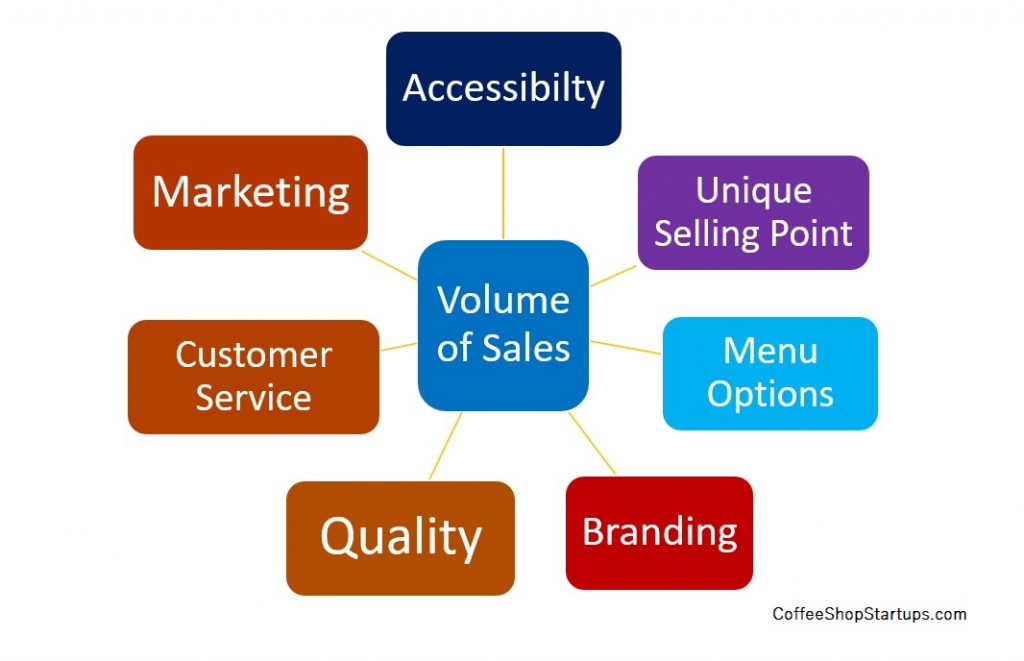
Ultimately, your coffee shop’s profit margin will lean heavily on these numbers. If your coffee business is steadily busy throughout the day or has spurts of caffeine-charged rushes that boost your customer numbers, your overall revenue will be higher.
A lot of different things may impact the number of sales. For example, your choice of location can impact your sales. The “better” the location for your coffee shop or drive-thru coffee stand, the higher the number of customers you will likely have.
Factors like parking, easy access, traffic flow, pedestrian walkways, street lighting, etc., are essential things to look at. Additionally, coffee shop marketing, promotions, and community outreach will also play an important role and can dramatically impact your sales numbers.
Next, you’ll need to factor in…
Your Average Receipt Total

Your average ticket size is one of the biggest factors affecting your coffee shop’s revenue and profitability.
Every customer spends a different amount. One person may order a simple brewed coffee for $3.50, while another purchases two specialty lattes, breakfast sandwiches, and pastries for $25 or more.
Your average ticket size is simply the average amount each customer spends per visit. To calculate it, divide your total sales by the total number of transactions.
For example, let’s say your typical customer orders a large Americano and a blueberry muffin for $4.95. We’ll use this number again later when we calculate your potential revenue.
One of the easiest ways to increase revenue is to increase your average ticket size. Offering pastries, breakfast items, premium espresso drinks, alternative milks, or retail coffee beans can encourage customers to spend a little more during each visit.
Even a modest increase of $1 or $2 per transaction can translate into thousands of dollars in additional annual revenue.
Combined with a steady increase in daily customer traffic, your average ticket size becomes one of the most powerful drivers of your coffee shop’s financial success.

Sales Volume & Ticket Size
Your total number of sales and average receipts are significant when calculating your overall gross revenue (before deducting costs).
It’s amazing how a small increase in both can really change your sales numbers—and coffee shop profits! To be more precise in your income forecasts, we suggest that you use real numbers for your particular coffee shop business.
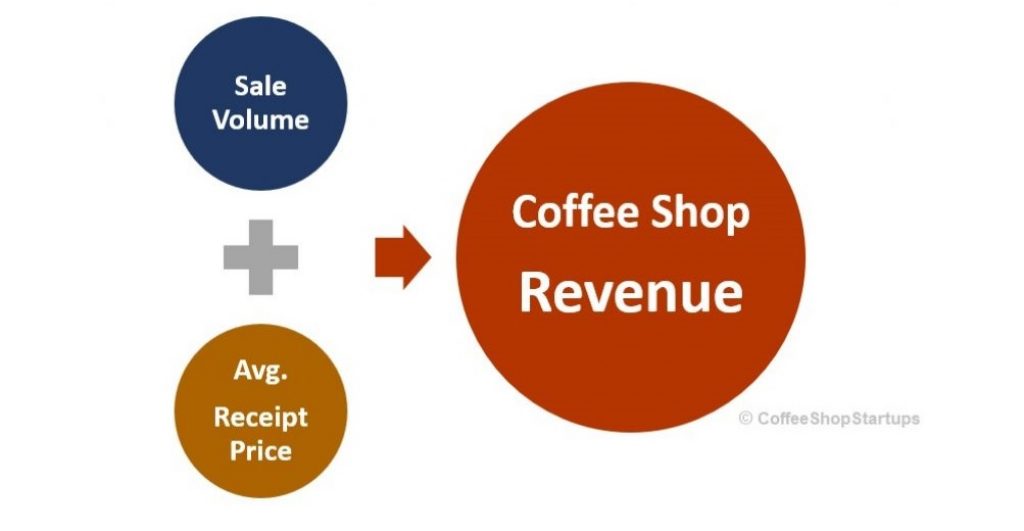
To determine your income, simply multiply the number of sales by the value of your average receipt.
Your Revenue Formula
Sales Volume × Average Ticket Size = Total Revenue
This simple formula is one of the most valuable planning tools you’ll use as a coffee shop owner.
While no one can predict revenue with complete accuracy, you can create realistic projections by estimating your daily customer count and average ticket size. From there, calculate your expected daily, weekly, monthly, and annual revenue.
I generally prefer working with weekly estimates because daily sales naturally fluctuate.
One final piece of advice: be conservative. Realistic projections lead to better budgeting, smarter decisions, and fewer surprises once your coffee shop opens.
Any over-the-top financial estimates only throw you off your ability to plan your coffee shop budget. Exaggerating your potential revenue will only hurt your planning.
So, let’s work with these numbers to determine how much money your coffee shop will make.
For the sake of fun (and we are having fun!), let’s assume that you have an average of 100 customers a day. Let’s also use the average receipt price of $4.95 (as noted above) for the following equations…
Gross Revenue for a Coffee Shop (Sample 1)
100 customers X $4.95 Average Receipt Price = $495 per day
$495 X 7 days = $3,465 a week
$3,465 X 4 weeks = $13,860 a month
$13,860 X 12 Months = $166,320 a year
As you can see through sheer multiplication, your coffee shop revenue compounds rather quickly to offer some significant returns for your business.
A modest number of customers (about 10 per hour) buying only $4.95 worth of coffee and muffins can quickly translate to significant revenue over the course of the year.
Now, of course, to increase the revenue of your coffee shop, you have a few choices:
- Increase customer volume
- Boost the average receipt price (by increasing product offerings, premium drinks, and costs per item)
- Do both
By leveraging any of the above factors, you will probably experience significant increases in your coffee shop revenue.
Boost Your Coffee Shop Revenue
Increase Sales & Profits
Let’s say you want to “up” your game and boost your coffee shop’s revenue. To do that, you decide to launch a low-cost community outreach effort to local churches, schools, and businesses. In a matter of a few weeks, your efforts begin to pay off…
You now turn your average of 100 customers per day into an average of 120 customers per day (By the way, that’s only two additional customers per hour!).
Next, you work hard to boost your average receipt by adding new products and in-house promotions and slightly boosting your prices by a modest percentage.
Let’s say that your average receipt is a modest $1.50 more than before, equaling $6.45 per receipt. (These numbers are possible for many coffee shops, cafes, bakeries, and drive-thru coffee businesses!)
- Increase Sales Volume by 20%
- Increase Average Receipt Price by $1.50
Okay, so let’s plug these numbers into the same equation (income formula) to get a new coffee shop revenue numbers adjustment.
Sample Gross Revenue for a Coffee Shop (Sample 2)
120 Customers X $6.45 Average Receipt Price = $774 per day
$774/day X 7 days = $5,418 a week
$5,418 X 4 Weeks = $21,672 a month
$21,672 X 12 months = $260,064 a year
Wow!
Did you see how two small adjustments to both of these elements can dramatically impact your coffee shop business revenue?
$166,320 or $260,064
It simply takes a small movement upwards in both variables to dramatically increase your revenue.
Don’t you think that’s possible?
Just remember, the difference represents only two more customers an hour, plus an average receipt price increase of only $1.50. It’s nearly $100,000 more per year in revenue!
While making $166,320 or $260,064 per year is appealing, this is NOT what you will be making personally and putting in your personal bank account.
As they say, “It takes money to make money.” Delivering your product takes money. And when you own a coffee shop, you’ve got expenses to take care of. So, let’s talk about those before booking your vacation flight to the Bahamas.
Let’s Move From Gross Revenue to Net Revenue…
In accounting, the costs associated with your sales are referred to as the Cost of Goods Sold (or COGS). You might also refer to them as operational costs or overhead costs.
Just a quick note:
In our Coffee Shop Business Plan Template (offered for free in our Complete Coffee Shop Startup Kit), we review in detail the costs associated with starting a coffee shop business.
Our kit also contains some incredible real-world interviews you will want to hear before planning your coffee business.
Next, let’s talk more specifically about the cost of doing business.
Further Reading: Requirements to Open a Coffee Shop

Subtracting Your Coffee Shop Costs
Your coffee shop requires money to operate.
The money it takes to operate your coffee shop—your operational costs—will need to be subtracted from your gross revenue (noted above). Operational costs are sometimes referred to as overhead costs or costs of goods sold.
Operational costs consist of fixed and variable costs.
Generally, these coffee shop costs include:
- Your lease (monthly rent)
- Labor costs
- Inventory
- Coffee equipment (includes installation costs)
- Paper supplies (cups, lids, straws, and napkins)
- Milk and condiments
- Insurance
- Utilities
- Any monthly interest on loans
There can be many other costs associated with starting a coffee shop, such as interest payments, payroll, administrative costs, and taxes.
You’ll need to know these total costs to determine your profit margin – or how much money you’ll be making after your total costs are paid.
Let’s continue with an example scenario below.
Sample Coffee Shop Cost Illustration
Let’s take a moment to calculate some sample startup costs that you will most likely encounter as a coffee shop owner.
Sample coffee shop startup costs:
- Rent (lease): $1900
- Insurance: $200
- Any interest on loans: $320
- Labor costs: $2500 (** May include your personal salary too!)
- Coffee inventory: $1400
- Paper supplies: $400
- Milk and ingredients: $700
- Utilities: $400
Monthly cost: $7820
As mentioned earlier, you can further divide this sample list into two categories: Fixed costs and variable costs. Knowing the difference is important because they impact your profit margins relative to your revenue generation.
Learn more about the costs of starting a coffee shop with our article, How Much Does it Cost to Start a Coffee Shop.
Consider the following coffee shop revenue:
In the examples above, we estimated a potential monthly revenue of $13,000 a month or $22,000.
Regardless of your revenue, your fixed costs do not change.
For example, whether you sell 1000 coffees or 300 coffees a week, your lease and insurance’s fixed cost remains the same. (Unless, of course, you are splitting a percentage of the sales with your property owner as a part of your lease agreement.)
While your variable costs will increase as you serve more coffee and increase staff or labor costs, you will see that the more you make, the higher the percentage of the actual revenue you will keep.
This is because the fixed costs of your coffee business do not increase as you make more money – only variable costs do.
For example, your insurance, interest, and lease costs will stay the same regardless of how much money you bring in, while your labor and inventory costs will increase as you make more sales.
Coffee Shop Fixed and Variable Costs
Fixed Costs – remain the same no matter how much money you make.
Variable Costs – Go up the more sales you make.
Your monthly fixed and variable costs make up your total operational costs. You’re going to subtract your operational costs from your revenue to determine your profits. For a more in-depth look at your coffee shop startup costs, read our post, Understanding the Costs of Starting a Coffee Shop.

Determining Your Coffee Shop Profits
To further explore your coffee shop profits and how it impacts your personal income as a coffee shop owner, we will have to subtract your operational costs from your revenue.
Remembering that your operational costs are synonymous with your Cost of Goods Sold (COGS), the formula is:
Total Revenue – Operational Costs = Your Profit Margin
Our two revenue illustrations above are rounded to $13,000 and $22,000, respectively. After adding up all the costs (both fixed and variable), we will get our profit margin.
In the second example, we will estimate an added variable cost of $1500. This cost would include additional milk, coffee, cups and lids, other wholesale costs, and labor.
Example 1:
$13,000 – $7,820 COGS = $5,180
Example 2:
$22,000 – $7,820 COGS – ($1,500 in additional COGS for increased business) = $12,480
You can go ahead and check my math, but this will give you an estimate of what you make as a coffee shop owner.
The difference can be stark. Even with the $1,500 in increased costs (due to spending more on coffee, products, and labor), your revenue still jumps up with those small changes.
Further Reading: How to Open a Coffee Shop Successfully
Coffee Shop Profits
From Revenue to Take-Home Income
 As the samples above show, just a few changes in your sales volume and receipt prices can dramatically affect your coffee shop’s profits—and, ultimately, your earnings as a coffee shop owner.
The final numbers indicate what you will be left with after you have finished paying your obligations (your lease, insurance, labor, taxes, inventory, etc.).
Reinvesting a Percentage of Your Profits
Covering your costs and generating profits is the ultimate goal of maintaining a healthy and profitable coffee business.
However, you will need to spend money to grow your coffee business even further. You will probably need to reinvest a percentage of your profits in the business.
The money could be used for more coffee equipment, barista training, furniture, fixtures, or expanding to a second or third location.
Besides, you may want to keep a financial cushion in your business bank accounts to avoid overdraft charges or pay for any unexpected expenses.
Let’s assume that you’ll take a regular percentage of your profit margin and either re-invest it or save it. We recommend saving or reinvesting 10% of your profit margin.
From there, whatever is leftover from net revenue is personal income. That is, this remainder will be the money you get to keep for yourself.
Consider the formula below.
Your Coffee Shop Revenue Formula:
(Consists of three simple calculations)
Total Revenue – Operational Costs = Profit Margin
Profit Margin X .10 = Your Reinvestment Money
Profit Margin – Allotted Reinvestment Money = Your Personal Income
Okay, so you’re going to take your total (gross) revenue and subtract your operational costs. This will give you your net revenue or your profit margin. Good business practice keeps some profits and re-invests them back into your business for growth and emergencies. After your allotted re-investment money is taken out, you end up with income that is yours.
How to Determine Your Coffee Shop Income
How to Claim Your Personal Income
You should speak with a bookkeeper or an accountant to decide how to withdraw money from your business bank account regularly. How you pay yourself could impact your personal and business taxes.
For example, do you want to earn a salary and live off that? Or would you like to transfer these remaining funds (which may vary monthly) into your personal bank account?
Consider the amount of money that you will need to live and be an effective business owner. Understanding how much you need to provide for yourself and your family will be important.
So, back to the original question…
How Much Income Do Coffee Shop Owners Make?
Money is an important factor in deciding your path. Is estimating your income important as a future coffee shop owner?
If you have read through this entire article, you’re probably in a better position to answer this question for yourself, especially when discussing your specific coffee shop business.
In this scenario, a small but steady coffee shop business can generate $5,000 to $20,000 in income a month (sometimes more and sometimes less).
Ultimately, your personal income is also determined by how many sales you get per month, subtracting your costs, and the rate of reinvestment money you want to put back into your coffee business.
You will also want to figure in your personal income taxes and other items, such as health care premiums, dental insurance, etc.

Calculating Your Coffee Shop Income
Estimated Annual Revenue
So, let’s figure it out even further…
Using the figures above, you can better determine your coffee shop’s profits: on average, a small-to-medium-sized coffee shop can produce between $55,000 and $168,000 in personal income per year. In both of these examples, we will multiply by .10 to determine your re-investment in your business. However, you don’t have to do this.
Example 1:
Revenue – COGS = $5,180 x .10 = $518
$5,180 – 518 = $4662
$4662 x 12 = $55,944 (Your Income)
Example 2:
Revenue – COGS = $12,480 x .10 = $1248
$12,480 – $1248 = $11,232
$11,232 x 12 = 134,784 (Your Income)
You don’t necessarily have to calculate your income in this manner. You can choose to do it daily, weekly, etc. However, you should maintain the same type of formula. The numbers in this scenario could be less or more when your business details are factored in.
Wait, so how much does a coffee shop owner make?
Ultimately, the answer is: It depends. It depends on your overall revenue, operational costs, and allowance for some money to be re-invested back into your business. It may also depend on how many years you’ve been in business.
We would not be wrong to estimate that a coffee shop owner makes between $55,000 and 240,000 per year—per location—with a small- to medium-sized coffee shop in an American city.
The good news is that you now know the basic variables that determine the answer that works for you and your coffee shop business planning.
Of course, if you have a small and moderately busy coffee business or a larger coffee business with several locations, your personal income will vary.
Remember… each coffee shop is different: variables like the location, costs, market share, price points, product profit margins, branding, and management all play an important role in determining your profits. Additionally, the more coffee shop locations you have, the more expenses and the more revenue you can make.

Other Related Income Questions:
How Can I Increase My Coffee Shop Profits?
Earlier in this post, we detailed an example path towards your personal income. However, the truth is that there are several ways to improve your coffee shop profits:
- Improve your sales volume
- Improve your receipt ticket prices
- Do both
Yet, there is another important element to improving your personal income. That is reducing your waste!
Waste, such as spilled drinks, spoiled milk, unsold food items, or overscheduling baristas, may seem insignificant. However, added together after every shift, every day, and every week, it can add up to quite a bit of lost revenue.
Below are some additional thoughts as to improving your revenue and profits:
Analyze your sales and costs daily
It will be important to regularly analyze what items you are selling and what costs you to sell them. If prices go up, you may have to switch vendors to keep your costs low.
In addition to your costs, analyzing why you have good sales is also important. Are customers responding to a particular Ad or promotion? Do you have monthly specials that customers are loving?
Having a good coffee shop POS system will help you determine many essential data that will make you better positioned to manage your sales and costs.
Your POS System could help determine your:
- Volume of sales
- Average receipt price
- Time of day you are generating revenue
- Popular and least popular items sold
- Trends during the week and month
For more information on your coffee shop POS system, read our post, Which Coffee Shop POS System is Best?
Reinvent Your Coffee Shop Menu
Adding items to your menu that your customers want can dramatically improve sales. Listen to your customers. Seek out their ideas and recommendations and slowly develop your menu board to reflect their willingness to buy. Even the smallest changes can open up new sales opportunities. For example, adding new syrup flavors, a new milk alternative, or vegan or gluten-free items may be a game-changer.
Coffee Equipment Improvements
To improve your sales, you may need additional coffee equipment. For example, you may need to switch out your one-group espresso machine for a two-group espresso machine. Additionally, you may need a larger refrigerator, a new ice-maker, a commercial blender, etc. You may need to get a toaster or larger display case. All these things may cost you money and help you generate additional revenue in the long run.
Barista Training
Training your baristas is a worthy investment. Barista training reduces waste, improves your service, improves your drinks, and improves your overall customer experience. Friendly baristas that serve amazing coffee will almost always generate repeat customers – and improve sales volume.
Up-selling Techniques
Upselling is important for any business. Respectfully recommending additional items that may accompany your customer’s purchase may complement their overall experience and improve your average ticket price.
Re-negotiate Your Lease
Once you sign your coffee shop property lease, you may have little recourse to change it before the lease expires. However, depending on any number of variables, you may be able to renegotiate your lease and reduce your rental payments or other obligatory expenses.
Plan for Holidays
Taking the time to plan out events around particular holidays may boost quarterly sales and impact your annual estimated revenue. Whether you have a Valentine’s Day sale, summer specials, Christmas events, etc., you can drive up sales with various promotions. For an in-depth discussion on increasing your coffee shop sales, read our post, How to Increase Your Coffee Shop Sales.

Ready to Get Started?
Start Your Dream Coffee Shop Business
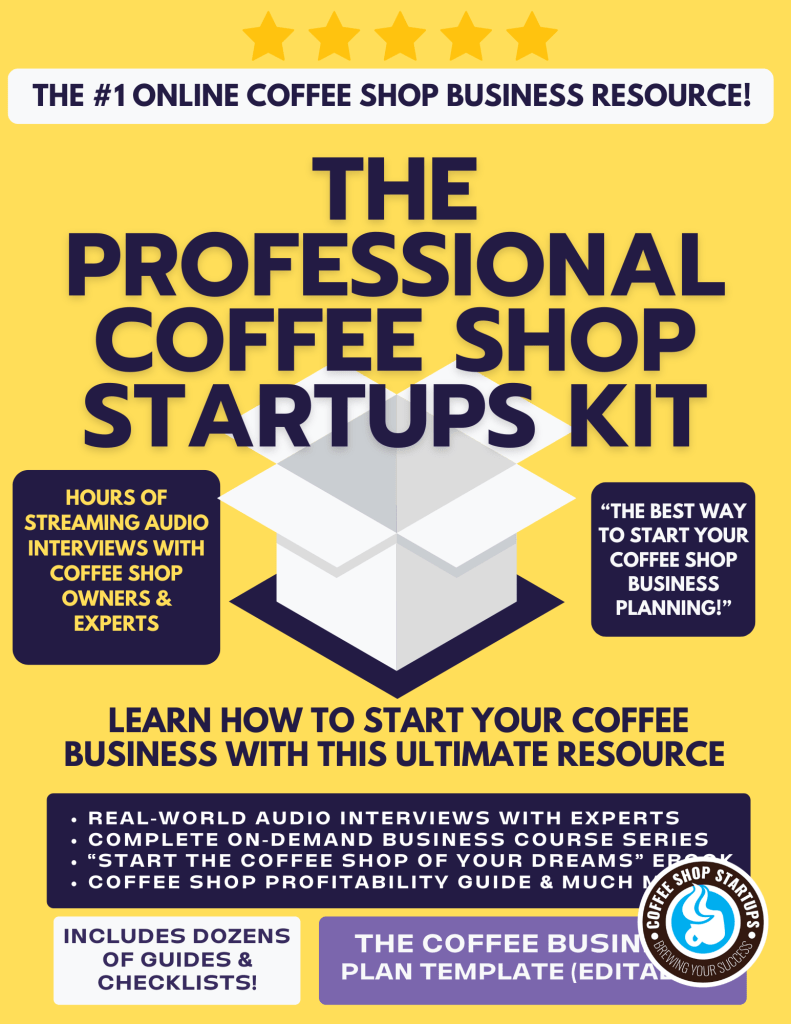
Starting a coffee shop is exciting, but it can also feel overwhelming. Where do you start? What steps should you take? How do you avoid costly mistakes? That’s where the Professional Coffee Shop Startups Kit comes in. It’s designed to give you a clear, practical roadmap to opening a successful coffee business—without wasting time or money on guesswork.
Inside, you’ll find:
 Expert interviews with real coffee shop owners and business experts.
An On-Demand 37-lecture course covering everything from business planning to daily operations.
Editable coffee shop business templates, financial documents, checklists, and planning tools to keep you on track.
A step-by-step startup guide that walks you through concept development, permits, branding, and more.
Cost-saving strategies to help you launch your coffee business on a budget.
Whether planning a small coffee cart or a full-scale café, this kit is built to help you start confidently. Join the thousands of successful coffee entrepreneurs who started with a dream and a great plan. Your journey to coffee shop greatness begins right here!
Comprehensive. Proven. Affordable.
The Professional Coffee Shop Startup Kit
(Instantly Delivered To You)
* The information on this page is for educational purposes only. We do not offer legal or investment advice.

Coffee Shop Startups
Based in Seattle, Washington, USA, Coffee Shop Startups is dedicated to providing you with the most relevant information on how to start a coffee shop business successfully. Over the last 11 years, we've helped thousands of aspiring coffee business owners worldwide. We harness the experience, wisdom, and knowledge of many successful coffee shop owners to help you increase your chances of success and profits. We support business owners who want to start a coffee business by providing them with valuable information on starting their coffee business successfully.